

Same Word, Opposite Meanings: Synonyms and Antonyms in India, the UK and the US
28 Sep, 2026
 By FastInfo Class
Published On 09 Jul 2026
Category English Communication Skills Training
By FastInfo Class
Published On 09 Jul 2026
Category English Communication Skills Training
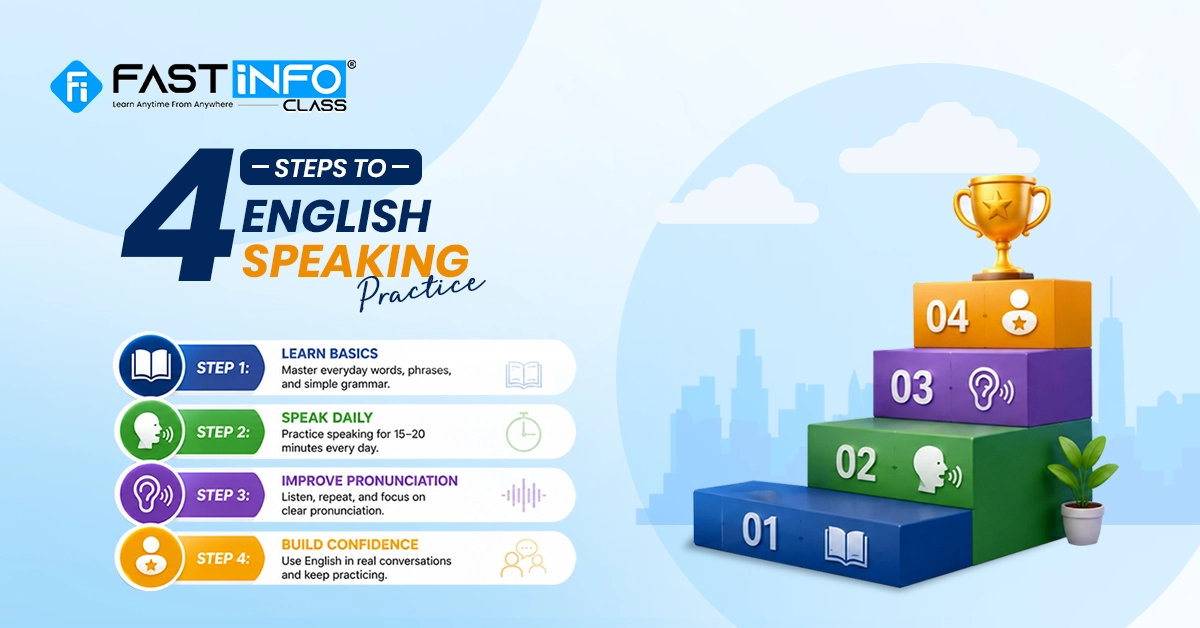
Many individuals want to speak English fluently and confidently. Regular English-speaking practice is an effective way to build communication skills. There is no need to go abroad in order to become fluent in this language. Consistent practice will help you to improve your communication skills, bring career opportunities, and help you connect with people globally. In this blog, you will learn about the methods to practice English speaking daily for better communication skills.
Below are some of the key importance of daily English speaking practice:
When an individual practices daily, their mind can connect thoughts and words in English without any delay. This regular practice helps you get used to producing English expressions immediately. It will also break the slow habit of translating the language from your native language. However, you will be able to respond faster, and speaking becomes easy and natural.
Regularly speaking helps you feel more comfortable while you make mistakes and learn from them. You should focus on communication skills rather than grammar. This will help you improve effectively.
Spoken English practice on a daily basis forms muscle memory in your mouth. It will train your ear to speak in a rhythmic way with proper intonation. If you do this practice regularly, you will be able to pronounce new sounds. You can also improve your articulation, speech pattern and make your voice sound natural.
If a learner memorizes a lot of isolated words, they can forget them quickly. English speaking practice on a regular basis allows you to use those words in real situations. This practice teaches your brain to move vocabulary from temporary memory into long-term memory.
Real conversation necessitates active participation from both people. Regular practice of speaking conditions your ears to allow you to get used to understanding the spoken words while you speak. In this way, you will be able to learn to understand different speaking speeds, various accents, and emotional tones in a conversation without losing concentration.
English is the common language that is used in international business, academia, and digital media. Speaking English fluently gives you a great advantage. You will get employment opportunities, have trouble-free travel to other countries, and create cross-cultural relationships effectively.
Here are some of the top ways to practice English speaking daily for better communication skills:
Talking to yourself is considered a solo exercise to improve spoken English. In this strategy, your brain will get engaged in speaking fluently. It will be done by translating thoughts into fluent speech without the pressure of an audience. To practice, you should share all your thoughts out loud during the day when you are alone. This practice helps to fill the gap between your thoughts and speech. It creates your mental muscle memory and teaches your brain to process English phrases automatically without the presence of a real conversational partner.
You should describe your daily routine, which means you have to narrate your actions, like a commentator. For example, you can say phrases such as “I am opening the fridge now” or “I am going to the office”.This means you are anchoring your English practice in reality. This will help to improve your use of common verbs, tenses, and daily vocabulary.
In this strategy, you must choose three new words each morning and try to use five unique spoken sentences with those words. You do not need to learn the meaning of words, but you should use them in sentences in a proper way. This confirms that you do not keep your learning words as passive information.
Listen to an audio track in English and repeat the words out loud almost simultaneously. This means you have to act as an echo and follow the audio in real time. This strategy allows your brain to adopt the natural cadence, flow, and delivery of English speaking.
Singing along to English music can be considered as an incredibly effective and enjoyable daily practice. You just need to put on your preferred English music, follow the lyrics, and sing it loudly. This will help you to improve your pronunciation skills. It is due to the use of your mouth muscles to mimic the linking, rhythm, and fast pacing of native speakers.
Mistakes are a necessary aspect of learning the language. You have to speak without hesitation rather than thinking of grammar. This will help to improve your communication skills and build proper confidence. You will also be able to teach your brain to think and speak naturally.
Joining an online English speaking course or a speaking club is another effective way to practice English speaking daily. These platforms offer 1-on-1 expert coaching, structured curricula, peer discussion clubs, and so on. This will help you with immediate corrections, build conversational fluency, reduce hesitation, etc.
You need to choose any topic and argue about its advantages and disadvantages in 2 minutes each. This activity will make you think quickly, structure your thoughts, and find suitable vocabulary words.
You can do a consistent English speaking practice by taking two minutes after watching a video, reading an article, or listening to a podcast. Then, you have to summarize it in your own words. Try to capture the main point, the arguments made, and the conclusion. This exercise will allow your brain to combine information quickly, structure complex thoughts, and use your vocabulary efficiently under pressure.
In this method, you should choose any random photograph, painting, or chart and spend at least one minute describing everything you see. Your description will include mentioning the colours used, objects, people, actions, and so on. Throughout this practice, you can develop your descriptive vocabulary, use prepositions in your speech, and prepare yourself to speak fluently about unfamiliar topics without any hesitation.
Consistent English speaking practice is an effective way to gain confidence, develop fluency, and communicate effectively in everyday situations. When you turn your regular practice into a natural habit, you will be able to become fluent in speaking English. Every conversation needs dedication, patience, and consistent effort over time. A proper practice also brings out your potential and improves your global career opportunities. However, you should make spoken English practice a part of your daily routine to improve your communication skills. If you need valuable guidance in speaking English, you can join FastInfo Class.
Q1. What are the best ways to do English speaking practice daily?
The best ways to do English speaking practice are talking to yourself in English, learning and using new vocabulary, singing along to English music, overcoming the fear of making speaking mistakes, describing visuals and images, and so on.
Q2. Can I practice English speaking alone at home?
Yes, you can practice English speaking alone at home by using the shadowing technique, self-talk, recording your voice to review your pronunciation, and much more.
Q3. How can I overcome fear and nervousness when speaking English?
You can overcome your fear and nervousness by focusing on communicating the message delivery instead of grammar perfection. Speak slowly, breathe deeply, and keep in mind that making mistakes is a natural part of learning.
Q4. Is reading out loud effective for improving spoken English?
Yes, reading out loud is effective for improving spoken English. It is because it develops your mouth muscles, improves pronunciation, and gets your brain used to the rhythm of English. However, you need to incorporate spontaneous talk to build fluency.

Same Word, Opposite Meanings: Synonyms and Antonyms in India, the UK and the US
28 Sep, 2026

The Ultimate Guide to Anagrams and Their History: Definition, Examples, and Hacks
18 Sep, 2026

How to Learn Spoken English for up to 500 Rupees per Month in India?
14 Sep, 2026

8 Best Online Spoken English Classes in India for Personalised Learning
09 Sep, 2026

How to Select a English Course for Interview Preparation
04 Sep, 2026


Daily English Conversation Practice for Beginners: 50 Useful Topics
29 Jun, 2023

Must Read Novels to Improve English for Beginners to Advanced
21 Feb, 2023

Top 15 Spoken English Books to Enhance Your Fluency
09 Sep, 2023

25 Commonly Mispronounced English Words in India
26 Apr, 2024

English Speaking Course for Beginners - Everything you must know
22 Sep, 2021








Copyright ©2026 FASTINFOCLASS. All Rights Reserved